
Nevada Casino Floor: What Is the Minimum Bet?
The minimum bet on a Nevada casino floor is not a courtesy number printed on a felt layout—it is a hard floor set by the property's hold calculation, and it shifts table by table, hour by hour. Walk into any Strip pit and you will see $10 minimums at 2 p.m. that mutate into $25 or $50 minimums by 8 p.m., because the floor manager is pricing seat time against expected drop, not accommodating your bankroll. 🎲
Strip the romance away and the mechanism is pure yield management. A blackjack table with seven seats at a $10 minimum projects a theoretical win of roughly $10 × 7 × 60 hands × 2% house edge, give or take the pace of the dealer. Bump the minimum to $25 and the property quadruples theoretical drop per seat without adding a single square foot of floor space. That is why the answer to "what is the minimum bet" is always: whatever the pit boss can extract from the next tourist in line.
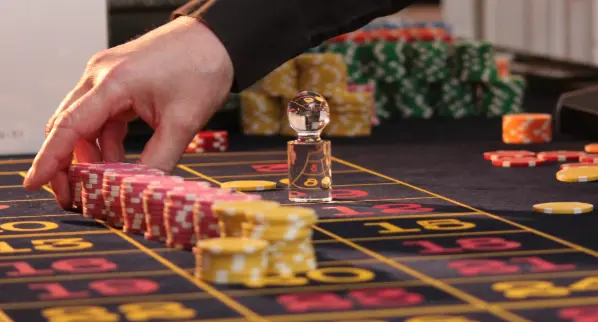
Downtown Versus the Strip: Two Different Floors
Downtown Las Vegas still runs $5 and even $3 minimums during slow mornings, and that is not generosity—it is a different cost structure. Older properties carry lower overhead and use cheap minimums as a loss-leader to fill seats and convert walk-ins into slot players. The Strip, by contrast, treats $10 as a defensive floor; anything lower invites low-yield grinders who occupy a seat for three hours and generate less drop than a single high-limit roulette spin.
Reno and the rural Nevada properties sit even lower. It is routine to find $3 blackjack and $1 roulette minimums in small-town casinos, because their competition is the gas station down the road, not the Bellagio. The moment you cross into a locals' casino in Henderson or North Las Vegas, the minimum bet drops back toward $5 and stays there. 🎰
The Real Variable: Table Type and Side Bets
Never assume the posted minimum covers the whole table. On a $10 blackjack game, the side bet—Perfect Pairs, 21+3, whatever the pit is pushing—usually carries its own $1 or $5 minimum, and the house edge on those side bets runs 3% to 7%, which is where the real money hides. The base game minimum is bait; the side bet is the margin.
Craps is a separate animal. A $10 pass-line minimum often allows $1 or $2 on the odds behind it, and that discrepancy is where sharp players live. The minimum bet on the flat bet is not the same as the minimum exposure the casino will tolerate on the odds. Ask the boxman directly—the answer is rarely on the felt.

Electronic Tables and the Hidden Floor
Electronic blackjack and stadium-style roulette terminals advertise $1 and $2 minimums, and technically they deliver. But the house edge on those terminals is typically 1% to 2% worse than the live game, and the machine enforces a max bet that funnels you into repeated small wagers. A $1 electronic minimum with a 4% edge is a worse deal than a $10 live game at 0.5%. The floor is lower; the trap is tighter.
Poker rooms operate on a completely different logic. The minimum buy-in is usually 20 to 50 big blinds, but the minimum bet in a fixed-limit game is set by the structure, not the pit. Nevada poker rooms post $2/$4 and $3/$6 limits that have not moved in a decade, because the rake—not the bet size—is the revenue engine. 😤
Timing the Floor: When Minimums Collapse
The single most exploitable fact on a Nevada casino floor is that minimums are negotiable at the margins of the day. Between 4 a.m. and 8 a.m., a pit boss staring at empty tables will often drop a $15 minimum to $10 or $5 if you ask and commit to a buy-in. By 11 a.m. the same table is back to $15. The minimum bet is not a posted law; it is a live price, and price moves with demand.
Ask for the floor supervisor, not the dealer. State your buy-in and your intended play time. A $300 buy-in on a $5 table at 6 a.m. is worth more to the pit than an empty felt, and they know it. If the answer is no, walk ten feet to the next pit—Nevada properties are dense enough that the competitive floor for your action is always within shouting distance, and the posted minimum at the next table over is the only number that should ever influence your decision to sit down.